
Explore More Taoist Living
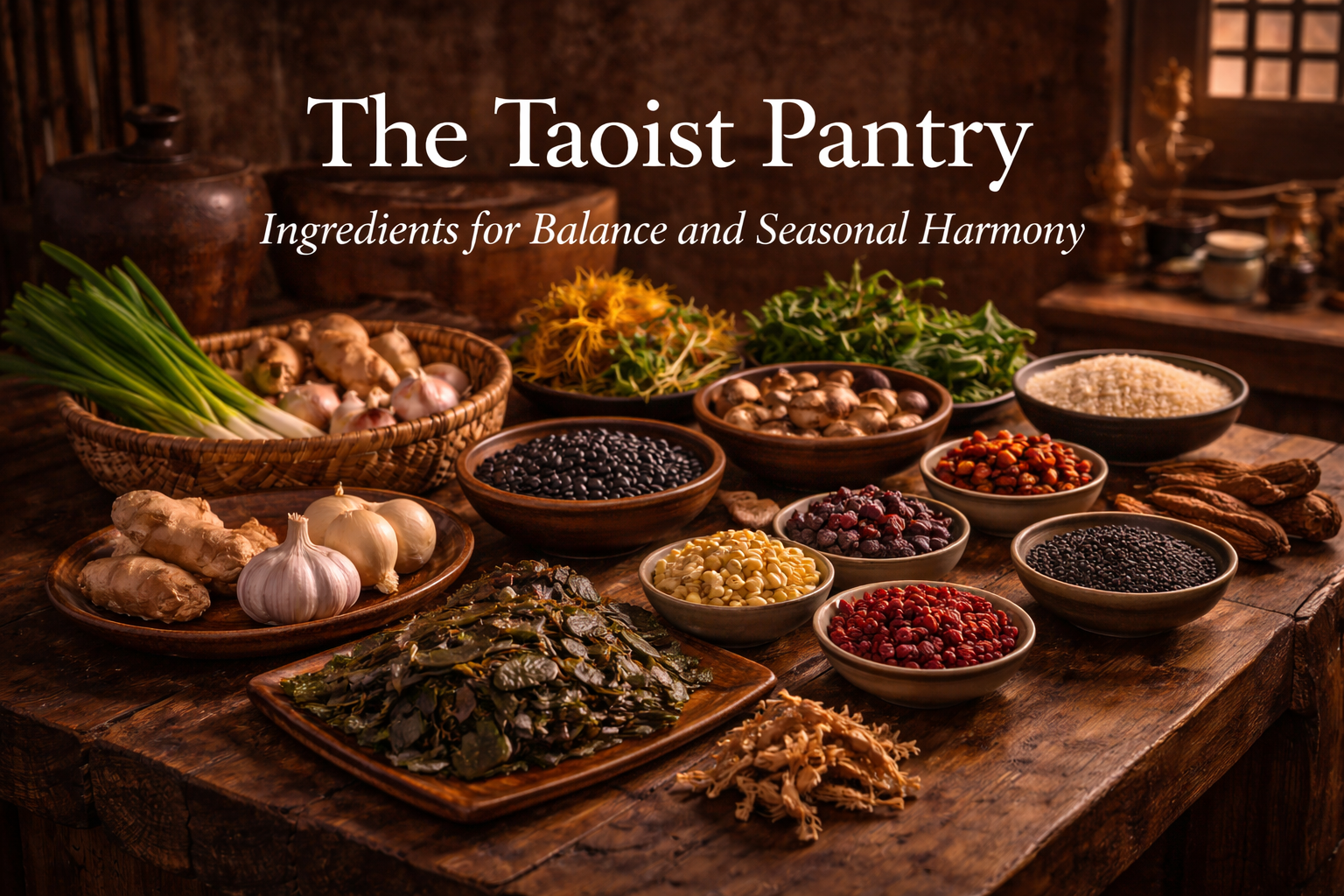
The Taoist Pantry
Ingredients for Balance, Season, and Everyday Harmony
Every kitchen begins with its ingredients. Before a meal is cooked or a recipe chosen, the pantry quietly shapes what is possible.
In a Taoist kitchen, the pantry is more than a collection of staples. It reflects a philosophy of balance — an understanding that food carries qualities that influence the body, the seasons, and the rhythms of daily life. Some ingredients warm the body and encourage circulation, while others cool excess heat or restore moisture during dry seasons.
Over centuries of Chinese culinary tradition, certain foods came to be valued not only for their flavor but for their ability to support harmony within the body. Grains that ground and nourish, herbs that stimulate or calm, beans and roots that restore strength — these ingredients form the quiet foundation of a Taoist-inspired kitchen.
Rather than strict rules or complicated formulas, the Taoist pantry offers a simple approach: keep ingredients that allow the cook to respond naturally to the changing seasons.
Aromatics
Awakening Warmth and Circulation
Aromatics form the starting point of many dishes. These ingredients gently warm the body and stimulate circulation, helping digestion and bringing energy into motion.
The most common aromatics in traditional Chinese cooking include ginger, garlic, and scallions. When heated in oil or simmered in broth, they release fragrance and warmth that spread through an entire dish.
Fresh ginger is especially valued in Taoist food culture. Its warming nature makes it useful in colder months, and it often appears in soups, teas, and broths meant to strengthen the body during winter. Scallions and garlic serve a similar role, adding brightness and depth while helping balance heavier foods.
In the Taoist pantry, aromatics are used not simply for flavor but to gently activate the body’s natural energy.
Grains
The Foundation of Nourishment
If aromatics awaken a meal, grains provide its foundation.
Rice, millet, and barley have nourished communities across China for thousands of years. Their simplicity and reliability make them central to everyday meals, and they are often valued for their ability to create steady, grounding nourishment.
Rice porridge — known as congee — is one of the most traditional expressions of this principle. Slowly simmered rice becomes soft and restorative, easily paired with vegetables, herbs, or small amounts of protein. In many households it is eaten in the morning or during times when the body needs gentle nourishment.
Millet and barley appear in similar roles, especially in seasonal soups and porridges. Their mild flavor allows them to carry other ingredients while providing the quiet stability that forms the base of a balanced meal.
Deep Nourishers
Foods of Restoration
Certain ingredients are traditionally associated with deeper nourishment and restoration. These foods often appear in winter cooking, when the body benefits from warmth and sustained energy.
Black beans are one of the most important of these ingredients. In Chinese dietary tradition they are believed to support strength and vitality, particularly when simmered slowly in soups or broths.
Mushrooms also play an important role. Varieties such as shiitake or wood ear add both flavor and texture to dishes while contributing minerals and earthy depth. Sea vegetables — including kelp and other seaweeds — bring a natural source of minerals that support overall balance.
Sesame seeds, especially black sesame, are another pantry staple valued for their richness and association with long-term vitality.
Together these ingredients form the backbone of many nourishing soups and stews.
Cooling Herbs and Fruits
Balancing Heat
As the climate grows warmer, the pantry shifts toward ingredients that help cool the body and maintain balance during summer heat.
Chrysanthemum flowers are often brewed into a delicate tea known for its refreshing, cooling quality. Mint and other light herbs serve a similar role, bringing clarity and freshness to drinks and dishes.
Fruits also play an important part in seasonal balance. Pears are especially valued in Chinese food culture for their moistening qualities and are often used in soups or gentle desserts during the dry months of autumn.
Goji berries appear frequently in both teas and soups, adding mild sweetness while contributing nutrients associated with vitality.
These ingredients demonstrate how the Taoist pantry adapts naturally to the changing needs of the seasons.
Food as Gentle Medicine
In traditional Chinese culture the boundary between food and medicine has always been fluid. Many ingredients used in everyday cooking are also valued for their restorative properties.
Jujube dates, for example, are often added to soups and teas for their gentle sweetness and calming qualities. Lotus seeds appear in both savory and sweet dishes and are traditionally associated with nourishment and balance.
Certain roots and herbs — such as ginseng or astragalus — may also appear in slow-simmered broths intended to strengthen the body over time.
In the Taoist pantry, these ingredients are not used as dramatic remedies but as subtle supports, woven quietly into everyday cooking.
The Quiet Foundation of the Taoist Kitchen
The Taoist pantry does not rely on elaborate ingredients or complicated preparations. Instead it is built from simple foods that allow the cook to respond naturally to the season, the climate, and the needs of the body.
A handful of grains, a few warming aromatics, nourishing beans and mushrooms, cooling herbs, and gentle medicinal ingredients — these are often enough to create a kitchen that supports balance throughout the year.
If the Taoist kitchen represents the practice of seasonal cooking, the pantry is its quiet foundation.
It is the place where philosophy becomes ingredients, and where the rhythms of nature are translated into everyday meals.